NEWS...
|
FIRE Act Grant Application Period Is November 4 - December 6
This U.S. Department of Homeland Security’s (DHS) Federal Emergency Management Agency (FEMA) has released the Fiscal Year 2013 Assistance to Firefighters grant program (FIRE Act) grant guidance and application kit. The application period for the FY 2013 FIRE Act grant program opens Monday, November 4, 2013, at 8:00 a.m. Eastern Time and closes Friday, December 6, 2013, at 5:00 p.m. Eastern Time.
More than $320,920 million is available for FIRE Act grants, less the 10 percent set aside for the Fire Prevention & Safety (FP&S) grants, to help fire departments and nonaffiliated emergency management service (EMS) organizations meet their fire fighting and emergency response needs.
The FIRE Act grant program supports organizations that lack the tools and resources necessary to more effectively protect the health and safety of the public and their emergency response personnel with respect to fire and all other hazards.
Grant guidance for this program is available here and here.
Click here for the “Get Ready Guide" to help answer questions and prepare grant applications.
The IAFF Grants Department is available to assist affiliates with the development and review of their fire department’s application.
For more information or to submit your application for review, email grants@iaff.org or call (202) 824-1575. |
Firefighters’ President Honors Prescott’s 19 Incredible “Brothers in Arms”
July 9, 2013 - “The men we lost in those hills lived and served for others – for all of us,” International Association of Fire Fighters General President Harold A. Schaitberger said in commemorating the lives of 19 fallen Granite Mountain Hot Shots at their memorial service today in Prescott, Arizona.
“Nineteen Brothers in Arms, bound together by the essence of the words ‘Honor’...’Commitment’... ‘Pride’...‘Courage’ and ‘Sacrifice.’ Incredible men, highly trained to endure conditions beyond the capacity of most of us.
“They were a unique band of men in the fire service, responding across the country to raging wildfires that the public only views through the prism of their televisions.
They were also 19 incredible husbands and husbands-to-be, fathers and fathers-to-be, sons, brothers and friends.
“But today we are all one family – the loved ones of the Yarnell Hills 19.
“But where the general public can usually hear the sirens and see the rigs and hoses in the streets, hot shots operate differently. Most of the time, this incredible Granite Mountain crew was invisible to the people they served – unseen, but no less important.
“These 19 fire fighters did what they were trained to do – they used the equipment they had and, as every crew does in every station in every fire department, they instinctively had each other’s backs.
“Most people don’t fully comprehend – can’t comprehend – the culture and the bond of our profession. We live together, work together, eat our meals together and put our lives in each other’s hands.
“The fact is, we have two families – at home and our fire fighting family on the job.
“And so our hearts and prayers go out to the families of the 19 Prescott fire fighters in Arizona who have made the ultimate sacrifice in protecting the communities they serve.”
The IAFF is asking that donations be made to the 501(c)3 relief fund organized by the United Phoenix Fire Fighters Association and Prescott Fire Fighter’s Charities. One hundred percent of all tax-deductible donations will benefit the families of the fallen members. To contribute, make your donation at any Chase bank using the following account information: United Phoenix Fire Fighters Association Account #987218757.
A website has also been established to obtain the latest updates concerning the 19 fallen firefighters and the Yarnell Fire. The web site is www.yarnellfallenfirefighters.com.
Please stay safe as we remember our fallen brother members.
Firefighters Press for Investigation of Blackwood Fire Chief
Gloucester Township Patch - June 6, 2013 - A union of professional firefighters is calling for the chief of a volunteer firefighting company to step down.
International Association of Fire Fighters Local 3249 are requesting an investigation of Blackwood Fire Chief John Vannoni over concerns about a fire department response on May 24, said Keith Kemery, the union president. The local wants the chief to step down during the investigation.
"This isn’t the first time we've had problems with Chief Vannoni," Kemery said.
The issue last month involved a dispatching error for a hazardous-material call. The dispatching error was quickly discovered, but Vannoni ordered his crew to stand down, Kemery said. He calls this is just the latest salvo in a long-running dispute with the chief, and says action needs to be taken.
"Local 3249 believes that Chief Vannoni’s actions were a deliberate attempt to attack the professional integrity and good names of Local 3249 represented career firefighters," said a letter presented to the Fire District 4 Board of Commissioners Wednesday. "Local 3249 further believes that Chief Vannoni’s latest actions represent a continued pattern of behavior that is predisposed to be adversarial and discriminatory toward full-time paid professional firefighters serving throughout Gloucester Township."
Fire District 4 oversees the Blackwood Fire Co. It's one of five fire districts in Gloucester Township and one of two that have paid and volunteer firefighters. Chews Landing also has paid and volunteer firefighters.
The letter also requested the commissioners investigate Vannoni's response on May 24 and an order by Gloucester Township's emergency management director to investigate the incident, Kemery said.
The board took no action on the letter because only two of five members showed up for the scheduled work session and there was no quorum.
Michael Jones, the chairman of the board, said he planned to forward the letter to the board solicitor, David Carlemere, who is also the township solicitor. When asked if he knew what the dispute was about, he paused for several seconds and then declined to comment.
Vannoni also attended the meeting. When asked about the allegations, he said he hadn't seen the complaint. When a reporter handed him the complaint, he took a few minutes to read the one-page letter, pausing to smile on several occasions, and then refused to comment.
$337.5 Million in SAFER Funding to Rehire and Retain Fire Fighters
The FY 2013 Staffing for Adequate Fire and Emergency Response (SAFER) grant application period will open on Monday, July 29, 2013, and remain open for 30 days. Congress has approved $337.5 million in SAFER funding to rehire and retain fire fighters. Of that $337.5 million, $20 million is set aside to hire military veterans with an extra year of funding for each veteran hired.
The SAFER program has put thousands of fire fighters back to work, giving a much-needed boost to public safety in countless struggling communities. Municipalities with fire departments facing reduced emergency response capabilities in particular should apply for SAFER funding. The IAFF urges affiliates to work with their fire chiefs and local lawmakers to file for the grants. City management must submit the application, but the IAFF is available to assist your community in applying for the grants.
These Get Ready Guides will help you be prepared to submit your application:
• 2013 SAFER General Get Ready Guide
• 2013 SAFER Hiring General Get Ready Guide
• 2013 SAFER Recruitment & Retention Fire Departments Get Ready Guide
• 2013 SAFER Recruitment & Retention Interest Organizations Get Ready Guide
SAFER self-evaluation sheets have been developed based on the scoring criteria used by peer reviewers. These tools will help you assess your readiness to apply for a grant.
• 2013 SAFER Recruitment & Retention Interest Organizations Self Evaluation
• 2013 SAFER Hiring Self-Evaluation
• 2013 SAFER Recruitment & Retention Fire Departments Self-Evaluation
System for award registrations (SAM) is a requirement for all applicants. Please click here and complete the SAM registration as soon as possible. SAFER applicants that have not completed the SAM registration process, or have not completed the required annual renewal and revalidation of data, will not be eligible to be awarded.
For questions about SAM, contact your State Assigned Grants Management Specialists.
• SAM registration requirement alert notification. Learn more.
• Register your organization in the System for Award Management (SAM), You will not be awarded a grant unless you are registered in SAM.
• If your organization is already registered, no action is required until that registration has expired.
• If your registration is expired, validate and update your information at SAM.gov.
The grant application process requires a significant amount of time to properly complete, therefore, the IAFF recommends that affiliates submit a draft version of their grant application to the IAFF Grants Department well in advance of the application deadline.
For more information, contact the Grants Administration Department at (202) 824-1575 or email grants@iaff.org.
Firefighters Union Backs EMS Move
Gloucester Township Patch - 7/5/2012 - While the overwhelming majority of those who addressed Township Council during Monday's special meeting expressed outright support for Gloucester Township EMS Alliance, not everyone did.
Some, like Valleybrook resident and Council meeting regular Darren Gladden, advocated for Council to give EMS Alliance a few weeks to correct deficiencies before it considered whether to go with Kennedy Health Systems for EMS coverage through December.
Then there was Keith Kemery, president of International Association of Fire Fighters (IAFF) Local No. 3249, the union that represents the career firefighters at four of Gloucester Township's six fire districts (Blenheim and Glendora districts, being all volunteers, do not have union representation).
It was clear Kemery neither supported EMS Alliance or wished to see Township Council give them a grace period to clean up things.
Kemery, a retired Blackwood Fire Co. firefighter, refuted many speakers, including now-former EMS Alliance Chief Tom Eden Sr., who claimed the move was one of a political nature.
"We lost our ambulances on June 26. And it wasn't the mayor that shut 'em down and it wasn't the chief of police," Kemery said. "It was the (New Jersey) Office of (Emergency Medical Services). I don't believe for a second that the state Office of EMS came in as part of an politically orchestrated event and shut down our ambulances."
The much-publicized June 26 shutdown caused "sufficient doubt" about EMS Alliance management to justify the township's move to Kennedy Health System, Kemery said.
While IAFF 3249 fully supports the township's decision to banish Gloucester Township EMS Alliance, it suggested in a statement that the move "should not cast a negative light on the dedicated rank-and-file emergency workers who actually staffed the ambulances and provided emergency services."
Gloucester Township Police Cpl. Sean Grannan, past president of Fraternal Order of Police Lodge No. 206, which represents Gloucester Township Police officers, spoke of criticism some have directed at Police Chief W. Harry Earle since the June 26 shutdown.
""This man has given you no reason to question his leadership, no reason to question his motives, no reason to question his actions. He's given you none. No reason to do so. And that is all I've heard this evening," Grannan said. "Please remember that—that the men and women of the Gloucester Township Police Department do not engage in these sort of things. We are the gatherers of fact. We are the gatherers of fact, to present them to the convening authority, and they are the ones to make the decision."
Earle presented a synopsis report to Council on the roughly 18-month investigation of EMS Alliance management by Gloucester Township Police Department Professional Standards Bureau during Monday's meeting.
Eden has maintained EMS Alliance was banished as part of a personal vendetta by Earle that dates back to Eden's October 2010 arrest on the charge of driving under the influence—a charge that ultimately was amended to reckless driving and Eden's May 2011 guilty plea.
"I was not driving. It was a hearsay charge. It's a political move by Harry Earle," he said.
Eden resigned his post during Monday's Council meeting, in a last-ditch attempt to spare his 45 employees. Following the meeting, Eden refuted Kemery's claim he had stepped down in the past, but still managed to run EMS Alliance.
"That's not true. I had somebody in place," he said. "She ran the show (as an interim chief)."
"She" is former EMS Alliance supervisor June Pacifico, who is no longer with EMS Alliance.
Council unanimously approved a resolution authorizing agreement between the township and Kennedy Health System. Kennedy will provide, at no cost to the township, two ambulances 24/7 and a third from 10 a.m. to 10 p.m., officials said.
N.J. Gov. Sends Back EMS Overhaul Bill, Again
For the second time, state legislators have tried to overhaul emergency medical services in New Jersey. And for the second time Gov. Chris Christie has told them to go back to the drawing board.
The bill (S-1650) would have increased state supervision of EMS, giving officials the authority to license paramedics and emergency medical technicians; require background checks on emergency workers; and establish minimum EMS standards for response times.
But Christie wrote in his veto message that the bill failed to address a series of issues that he raised when he vetoed an earlier version, including its effect on property taxes and EMS volunteers.
U.S. Attorney General Unveils PSOB Changes
More changes are on the horizon for PSOB -- one to include fire police officers and another to streamline the filing process.
NEW JERSEY PUBLIC SERVANTS MAY HAVE LAW ON THEIR SIDE IN PENSION BATTLE
CLIFFVIEW PILOT.COM - February 26, 2011 - The latest bombshells in the battle between Gov. Christie and New Jersey public servants -- just days from a huge rally in Trenton -- come in the form of advisory letters that say state lawmakers can't change a public employee's pension once he or she has put in five years on the job. In an August 2006 letter to the state treasurer, then-Attorney General Zulima Farber wrote that the state Legislature in 1997 "set the benchmark" at five years of service for police, firefighter and teachers union members to have "non-forfeitable rights" to current pension benefits.
In addition, a letter that same week from the state Legislature's legal counsel bluntly states that the right to benefits for anyone who has completed five years of service "cannot be reduced."
"Legislation that has the effect of detrimentally altering the retirement benefits of active members of State-administered retirement systems who have accrued at least five years of service credit, or of retired members, would be unconstitutional as violative of the federal and State constitutional proscription against impairment of the obligation of contracts," the letter to the Joint Legislative Committee on Public Employee Benefits Reform says.
So even if Christie does convince the Legislature to accept his reforms, a court could overrule any attempts to "substantially impair" pensions for those public servants who've already put in five years, according to Assistant Attorney General John P. Bender, who prepared the advisory letter for Farber.
The state would then have to show it had a "significant and legitimate purpose" -- and, more importantly, that lawmakers basically had no other choice, it says.
"A court will look to whether the legislative objectives could have been achieved by a less drastic alternative, including one that does not impair contractual rights," New Jersey case law states.
"The more substantial the impairment, the greater the level of scrutiny to which the law will be subjected," it adds. "The courts will not simply allow the State to walk away from its financial obligations."
Farber's letter cites "the well established treatment of pension laws by New Jersey courts." These traditionally have been decided "most favorably to the employee's interests.""Because the length of service varies for each employee covered by a state pension system, this act has had the effect of creating different categories of employees," the letter says:
While the law automatically vests anyone with 10 years of "creditable" service, "the extent of the non-forfeiable benefits for individual employees is determined not at the time of vesting but with reference to the benefits provided by law for that pension system when the employee accrued 5 years of service credit... but have not yet vested."
Those with less than five years aren't totally out of luck. Farber's letter points out that a court could reject pension cuts for that group if they "result in large tax liabilities for the trusts and the plan members."
Lawmakers can still "alter, modify or amend" the pension system, the advisory letter says. The current pension law in New Jersey also doesn't apply to post-retirement medical benefits, it notes.
"Pensions for public employees serve a public purpose," wrote Albert Porroni, then the state Legislative Counsel.
“It is common knowledge that a pension is an element in encouraging qualified individuals to enter and remain in public service,” Porroni quotes from state law, adding: “Deferred compensation benefits have been earned by an employee and are no longer considered a gratuity.”
By reducing pension benefits for those who already, under state law, are protected "would be impermissably impairing the obligation of a contract to which it is a party," Porroni's letter says.
When state legislators enaced the law, they "did not reserve the right to unilaterally adopt substantial modifications of the pension program," it adds. "More modest means of saving or raising money are available to the State that do not affect contractual obligations."
CHRISTIE CAMPAGIN LETTER PROMISED 'NO HARM' TO POLICE, FIREFIGHTER PENSIONS
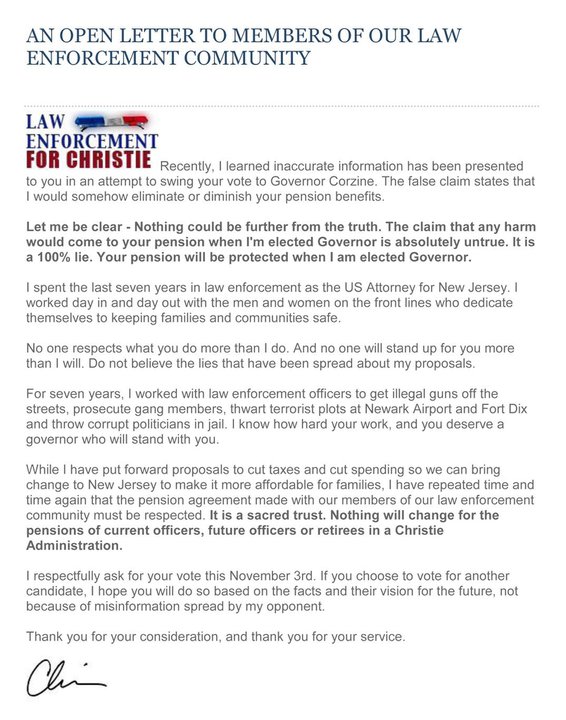
CLIFFVIEW PILOT.COM - February 25, 2011 - "The claim that any harm would come to your pension when I'm elected Governor is absolutely untrue. It is a 100% lie," Chris Christie wrote to New Jersey law enforcement officers during his campaign against Jon Corzine. The 2009 letter, and a near-carbon copy sent to firefighters, has resurfaced amid Christie's bid to overhaul public servants' pension system.
"Nothing will change for the pensions of current officers, future officers or retirees in a Christie Administration," says the "Open Letter to Members of Our Law Enforcement Community," simply signed "Chris."
"I have repeated time and time again that the pension agreement we made with our member our law enforcement community must be respected," the 2009 letter adds. "It is a sacred trust."
Christie sent a similar "sacred trust" letter to firefighters through the state, adding: "The notion that I would eliminate, change, or alter your pension is not only a lie, but cannot be further from the truth.
"No one will stand up for you more than I will."
"Do not believe the lies that have been spread about my proposals," Christie told both groups. "Your pension will be protected when I am elected Governor."
 |
Democratic Governors Must Defend Labor, or Lose an Ally
Conservative governors have launched an all-out effort to destroy unions and Democratic governors must stand up and defend the movement that has supported them for so many years.
That was the unvarnished message IAFF General President Harold A. Schaitberger delivered to the Democratic Governors Association assembled in Washington February 25 at the Capital Hilton.
In a closed door meeting with the nation’s Democratic governors, Mr. Schaitberger made it clear that the concerted attack on unions has nothing to do with the economy and everything to do with crippling Democrats’ most loyal and effective ally.
“They are using the economy to promote their own political agenda, and that agenda is to kill unions. It’s totally political and has nothing to do with the economy or budgets,” Mr. Schaitberger said. “This is about destroying the labor movement and the Democrats greatest ally. Take labor’s money off
the table and take labor’s shoe leather off the campaign trail and Democrats lose.”
Mr. Schaitberger told the governors that IAFF affiliates fully understand the challenges state lawmakers face in trying to manage states with dwindling resources. He reminded them that fire fighters have been feeling the effects of the recession as much as any other group of workers.
“Our members are contending with layoffs, closing companies and reducing levels of service. Response times are increasing and communities are less secure,” Mr. Schaitberger said. “But our members are also giving back with salary freezes or cuts, furloughs, cost shifting on health care, attacks on our pensions, reductions in benefits and other cost cutting measures.”
It has been painful but these sacrifices were made by legislatures or at the bargaining table for economic reasons.
“But now something ugly and unacceptable is occurring,” Mr. Schaitberger said. “After the mid-terms the mood changed. Governors, mostly Republican, but also some Democrats, have painted targets on the backs of public employees.”
He listed the numerous states where governors had launched legislative proposals clearly aimed at crippling unions.
Right now there are right to work measures in 13 states, paycheck deception proposals in 15 states, attacks on prevailing wage, to eliminate dues deduction, our defined benefit pensions, cost shifting on health care and even attempts in eight states to eliminate bargaining rights.
Mr. Schaitberger made it clear that it was now time for Democratic governors to stand with labor and beat back this coordinated assault, or risk further erosion of their political influence in the states and in Washington.
“Stand up for us. We’re there for you and you need to be there for us,” Mr. Schaitberger said. “You need to stand up for the process, the collective bargaining process. It works. It’s a basic right that built the middle class in this country and the push to eliminate us will hurt all of you tremendously.”
Mr. Schaitberger also pointed out that most of the public worker pensions were healthy, and those that were underfunded were that way because governments had failed to make their scheduled payments into the systems over the years.
“So, there’s plenty of ammunition for our friends -- you -- our Democratic Governors to push back with. And, that’s what we want and expect,” Mr. Schaitberger said.
Schaitberger concluded by thanking Maryland Governor and DGA Chair Martin O’Malley for publicly standing up for workers and unions in defense against the attacks by GOP governors like Chris Christie of New Jersey and Scott Walker of Wisconsin.
|
To receive the latest
additional information regarding Federal Legislative Issues affecting the
fire service, please click here.
To receive the latest
breaking news about the fire service, click
here to be linked to the Professional
Firefighters Association of New Jersey web site.
|